How to Use a Garden Hoe
Garden hoe
rab a sturdy garden hoe and slice weeds at their roots, break compacted soil, or shape planting rows with ease. A sharp, well-chosen garden hoe transforms tough garden chores into satisfying work. Learn proper grip, swing techniques, and simple tricks to keep your trusty garden hoe in top shape, your garden beds will thank you.
Using A Garden Hoe Well
- Effective garden hoe usestart with
- Choose and fit hoepick type
- Use core techniqueprotect soil
- Time and conditions
- Work around crops
- Maintain sharp and stored
- Select hoe style by job
- Match handle and grip
- Shallow slicing, not digging
Article mapOpen the visual summary
Using A Garden Hoe Well
- Effective garden hoe usestart with
- Choose and fit hoepick type
- Use core techniqueprotect soil
- Time and conditions
- Work around crops
- Maintain sharp and stored
- Select hoe style by job
- Match handle and grip
- Shallow slicing, not digging
Table of Contents10 sections
- Why a Garden hoe still earns a place in my shed· 1 min
- Know your hoe: quick taxonomy that actually matters· 2 min
- The core technique that saves your back and your soil· 1 min
- Timing that makes weeds surrender· 1 min
- Moisture, heat, and physics· 1 min
- Bed layout that makes hoeing fast· 1 min
- Ergonomics that feel like cheating· 1 min
- Sharpening that actually sticks· 1 min
- Soil health and the light touch· 1 min
- How I use each style of garden hoe for real jobs· 2 min
Why a Garden hoe still earns a place in my shed
I reach for a hoe before coffee has cooled because it rewrites a weedy morning into a clean row by lunch. A sharp blade, dry soil, and a lazy sun will do most of the work.
Know your hoe: quick taxonomy that actually matters
Collinear hoe
Razor-thin blade used nearly parallel to the soil, surgical in tight plantings.
Scuffle hoe (Dutch)
Sharp leading edge, pushed to shave seedlings just under the surface.
Stirrup or oscillating hoe
U-shaped loop that rocks and cuts on push and pull, fast in pathways and beds.
Draw hoe (American or chopping)
Flat blade that pulls soil toward you for furrows, hilling, and brutal roots.
Eye hoe (Azada)
Heavy, forged, for clay and sod where lighter hoes stall; foundational chopping tool when soil is toughest.
Draw hoe (American or chopping): flat blade, pulls soil toward you for furrows, hilling, and brutal roots. Scuffle hoe (Dutch): sharp leading edge, pushed to shave seedlings just under the surface. Stirrup or oscillating hoe: U-shaped loop that rocks and cuts on push and pull, fast in pathways and beds. Collinear hoe: razor-thin blade used nearly parallel to the soil, surgical in tight plantings. Warren hoe (triangle): pointy for seed furrows, onion rows, and between drip lines. Eye hoe (Azada): heavy, forged, for clay and sod where lighter hoes stall. Wheel hoe: two-handed, wheeled frame with sweeps or oscillating blades for bigger plots.
- Draw hoe (American or chopping): flat blade, pulls soil toward you for furrows, hilling, and brutal roots.
- Scuffle hoe (Dutch): sharp leading edge, pushed to shave seedlings just under the surface.
- Stirrup or oscillating hoe: U-shaped loop that rocks and cuts on push and pull, fast in pathways and beds.
- Collinear hoe: razor-thin blade used nearly parallel to the soil, surgical in tight plantings.
- Warren hoe (triangle): pointy for seed furrows, onion rows, and between drip lines.
- Eye hoe (Azada): heavy, forged, for clay and sod where lighter hoes stall.
- Wheel hoe: two-handed, wheeled frame with sweeps or oscillating blades for bigger plots.
The core technique that saves your back and your soil
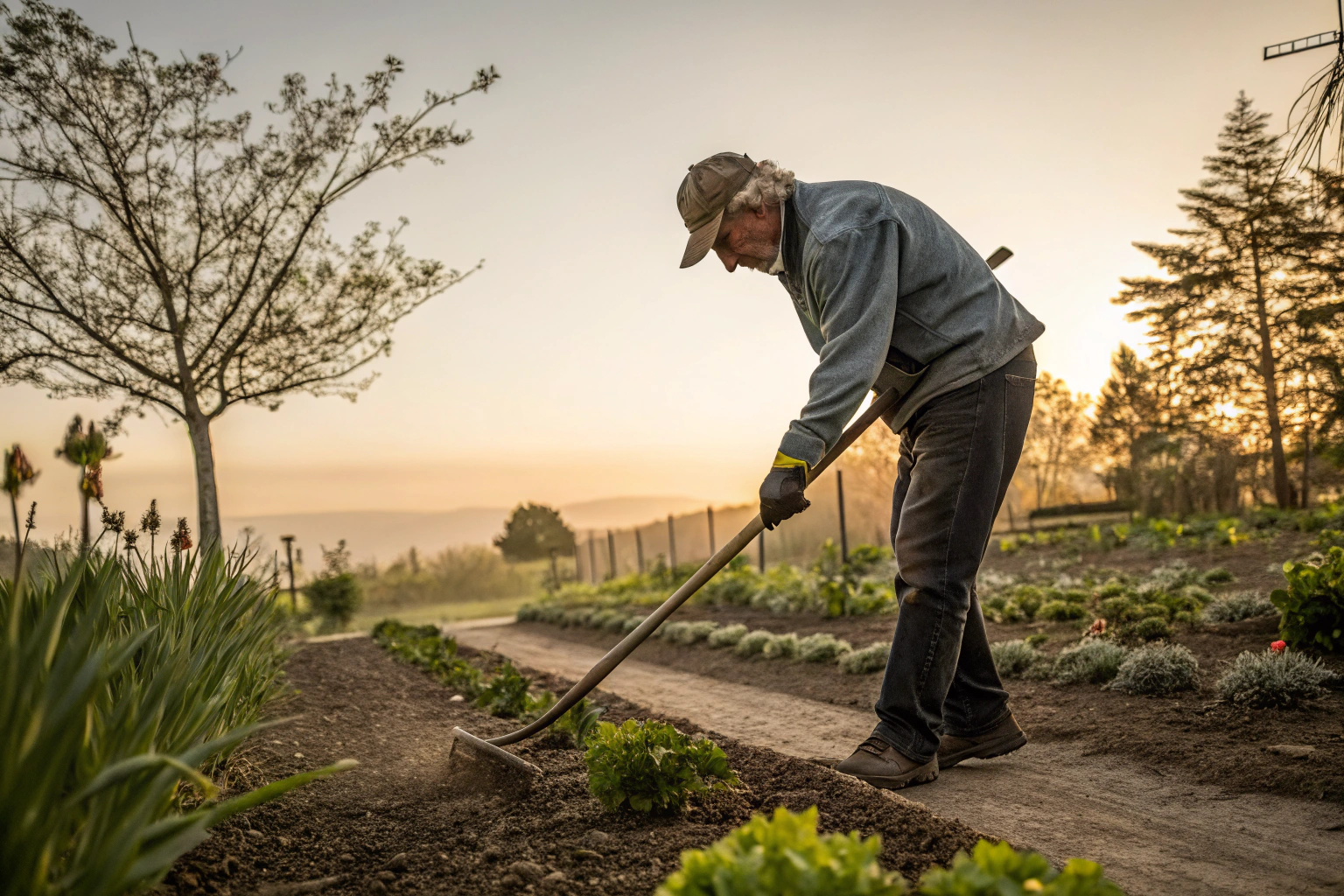
Work shallow, about 0.5 to 1 inch deep, which is 1 to 2.5 cm. You slice, you do not dig.
Keep the blade at a low angle, roughly 10 to 20 degrees to the surface. Let sharp steel skate like a chef’s knife on a tomato skin.
Use small strokes with steady rhythm, arms loose, legs doing the travel. On a stirrup hoe, let the blade do the rocking so you float under the crust and clip everything at the root collars.
Stand tall and pull toward you to shape beds and hill potatoes. Tip the corner to sneak between seedlings without lifting weed seeds to light.
Timing that makes weeds surrender
Hoe when seedlings are in the white-thread stage, before true leaves. Midday on a dry, breezy day turns severed weeds into confetti.
I prep beds, irrigate once, wait 7 to 10 days, then skim with a scuffle hoe before sowing. That round knocks out the first flush so crops launch ahead.
Moisture, heat, and physics
Soil should be dry at the surface so cut weeds desiccate. I aim for afternoons above 80 F, about 27 C, then leave debris right there as armor.
If clay clods form, I wait a day after rain or run a brief irrigation to settle dust, then slice shallow to avoid lifting a brick.
Bed layout that makes hoeing fast
Standardize bed width to match your hoe’s swath, so two or three passes finish a row. Keep drip lines tight to the row and pathways clear, which gives you clean lanes for fast strokes. Mulch pathways with wood chips and hoe only the crop band, a trick I lifted from market gardens.
- Standardize bed width to match your hoe’s swath, so two or three passes finish a row.
- Keep drip lines tight to the row and pathways clear, which gives you clean lanes for fast strokes.
- Mulch pathways with wood chips and hoe only the crop band, a trick I lifted from market gardens.
Ergonomics that feel like cheating
Handle length should land near armpit height, which keeps your back neutral. I choke up on the shaft for finesse, then slide hands apart for long passes.
Use legs to glide, not wrists to stab. A sharp hoe floats, a dull hoe fights you.
Sharpening that actually sticks
I file before each session with a 10 inch mill file, pushing in one direction to set a 25 to 30 degree bevel. Two minutes changes the day.
Afterward I wipe with light oil like camellia or boiled linseed and hang steel off the ground. A touch of vinegar removes sap and rust without fuss.
Soil health and the light touch
Shallow hoeing keeps dormant seeds buried and leaves soil structure intact. I avoid flipping chunks that wake a fresh seed bank.
In living mulches, I skim between plants and clip escapes, then top up with composted leaves to block light for the next flush.
How I use each style of garden hoe for real jobs
- Grab scuffle hoe for carrots and saladUse at first hint of threads, every 5 to 7 days in spring.
- Grab stirrup hoe for pathways and tomatoesFast weekly passes between young tomatoes keep Bermuda rhizomes tired.
- Grab collinear hoe for lettuce plantingsBlade rides flat so I never bruise a stem in lettuce close plantings.
- Grab draw hoe for hilling potatoes and leeksPull clean soil while shaving inter-row weeds.
- Grab Warren hoe for shallow seed furrowsMake seed furrows 0.5 inch deep, about 1.2 cm, and work around drip emitters without carnage.
- Grab eye hoe for new ground and bindweedShort chops cut crowns of heavy bindweed before they breathe.
- Grab wheel hoe for long 50 foot bedsUse oscillating sweeps on 50 foot beds, about 15 m, for two passes and done.
Scuffle hoe: carrots, beets, and salad beds at first hint of threads, every 5 to 7 days in spring. Stirrup hoe: pathways and between young tomatoes, fast weekly passes keep Bermuda rhizomes tired. Collinear hoe: lettuce close plantings, blade rides flat so I never bruise a stem. Draw hoe: hilling potatoes and leeks, pulling clean soil while shaving inter-row weeds. Warren hoe: seed furrows 0.5 inch deep, about 1.2 cm, and around drip emitters without carnage. Eye hoe: new ground and heavy bindweed, short chops that cut crowns before they breathe. Wheel hoe: 50 foot beds, about 15 m, with oscillating sweeps for two passes and done.
- Scuffle hoe: carrots, beets, and salad beds at first hint of threads, every 5 to 7 days in spring.
- Stirrup hoe: pathways and between young tomatoes, fast weekly passes keep Bermuda rhizomes tired.
- Collinear hoe: lettuce close plantings, blade rides flat so I never bruise a stem.
- Draw hoe: hilling potatoes and leeks, pulling clean soil while shaving inter-row weeds.
- Warren hoe: seed furrows 0.5 inch deep, about 1.2 cm, and around drip emitters without carnage.
- Eye hoe: new ground and heavy bindweed, short chops that cut crowns before they breathe.
- Wheel hoe: 50 foot beds, about 15 m, with oscillating sweeps for two passes and done.
Common mistakes and quick fixes
Going too deep: you churn up more seeds; reset angle and glide shallow. Hoeing wet soil: roots reattach; wait until the crust dries and sun returns. Dull blade: feels like work; sharpen until it shaves a thumbnail. Waiting too long: true leaves resist; schedule small, frequent sessions.
Buying guide for a garden hoe that fits the work
Forged steel holds an edge longer than stamped sheet and glides cleaner. Ash or hickory handles flex and outlast cheap softwood, while fiberglass shrugs off rain.
Pick head widths to match your beds: 3 to 4 inches, about 7.5 to 10 cm, for tight crops; 6 inches, about 15 cm, for open rows and paths. If you garden bigger than a backyard, a wheel hoe pays back in one season.
Weed biology that a hoe exploits
Annuals die quick at cotyledon stage because carbohydrate reserves are tiny. Perennials need repeat cuts to starve crowns and rhizomes for several weeks.
I log weekly hits on field bindweed for 6 to 8 weeks and watch regrowth weaken. Patience wins where brute force stalls.
Irrigation patterns that help the blade
Water deeply, then rest the surface dry for two days before hoeing. That pause starves shallow roots and sets up a clean slice.
Drip beats overhead because foliage stays dry while the top layer crisps. I hoe late afternoon and irrigate the next morning.
Working around crops without casualties
Angle the blade away from stems and slide past in a crescent arc. I finish with a hand weeder right at the crown instead of gambling with steel.
On seedlings, I leave a weed-free collar the size of a mug, about 3 inches or 7.5 cm, then return in three days to finish stragglers.
Maintenance and storage
Hang tools to keep edges away from concrete and moisture. Winter gets a wax on wooden handles and a light oil on steel.
Once a season I re-seat loose heads with a wedge or replace a split handle before it surprises me mid-stroke.
Numbers and references I trust in the field
University extension guides echo the shallow, early approach. UC ANR and Cornell recommend slicing at the seedling stage to avoid bringing new seeds to light.
RHS guidance aligns on dry-day hoeing for best kill and less regrowth. SARE’s stale seedbed data tracks with what I see on vegetable beds each spring.
Pro moves from the heat of July
I carry a file in my back pocket and touch up at the halfway mark. Ten strokes per side, back to gliding.
On 95 F days, about 35 C, I hoe after lunch and walk away. By dinner those seedlings look like tea leaves.
Alternatives and companions to the garden hoe
Flame weeder: pre-emergent pass on stale beds, then hoe follow-ups only. Mulch: wood chips in paths and compost in rows cut hoe time in half. String trimmer: edges and fence lines where steel cannot reach safely.
Safety without fuss
Closed-toe shoes, gloves, and eyes up for irrigation lines and mulch fabric. I keep pets and kids out of the lane while I work.
Set the hoe down blade flat when you step away. A dropped blade finds ankles fast.
FAQ lightning round
- Slice annual weeds on a dry dayAnnuals rarely regrow if sliced shallow on a dry day.
- Repeat on perennials as they re-sproutPerennials try and need repeats after cutting.
- Hoe weekly in spring, less in midseasonWeekly in spring flushes, every two weeks in midseason, and before each direct seeding.
- Keep hoe depth to 0.5-1 inchHalf to one inch, about 1 to 2.5 cm, is the sweet spot.
- Wait to hoe until soil surface driesWait until the surface dries so slices stay clean and roots cannot reattach.
- Consult key weed management resourcesSee Sustainable Agriculture Research and Education, UC ANR, Cornell Cooperative Extension, and the Royal Horticultural Society.
Do cut weeds regrow? Annuals rarely do if sliced shallow on a dry day, perennials try and need repeats. Can I hoe after rain? Wait until the surface dries so slices stay clean and roots cannot reattach. How often? Weekly in spring flushes, every two weeks in midseason, and before each direct seeding. How deep? Half to one inch, about 1 to 2.5 cm, is the sweet spot for speed and minimal disturbance.Sources worth your time Sustainable Agriculture Research and Education, weed management and stale seedbed guidance. University of California Agriculture and Natural Resources, Integrated Pest Management weed control recommendations. Cornell Cooperative Extension, vegetable weed control and cultivation timing. Royal Horticultural Society, hoe types and technique tips for temperate gardens.
- Do cut weeds regrow? Annuals rarely do if sliced shallow on a dry day, perennials try and need repeats.
- Can I hoe after rain? Wait until the surface dries so slices stay clean and roots cannot reattach.
- How often? Weekly in spring flushes, every two weeks in midseason, and before each direct seeding.
- How deep? Half to one inch, about 1 to 2.5 cm, is the sweet spot for speed and minimal disturbance.
- Sustainable Agriculture Research and Education, weed management and stale seedbed guidance.
- University of California Agriculture and Natural Resources, Integrated Pest Management weed control recommendations.
- Cornell Cooperative Extension, vegetable weed control and cultivation timing.
- Royal Horticultural Society, hoe types and technique tips for temperate gardens.
Cheatsheet: Master Fast, Efficient Hoeing
Essential Tools
Equip with a draw, stirrup, or scuffle hoe, sharpening file, and gloves.
Effective Weeding
Remove 90% of young weeds before they seed to boost crop health.
Optimal Timing
Hoe in dry soil during late morning or afternoon for best results.
Ergonomics and Safety
Stand straight and use both hands; wear gloves to avoid blisters.
Hoeing Techniques
Slice under the surface (1" deep) smoothly; clear debris post-hoe.
Pro Tips
Weed weekly and mulch afterwards to retain moisture and suppress future growth.
Want a more guided way to practice garden hoe?
Frequently Asked Questions About Mastering Your Garden Hoe
Which garden hoe style best suits vegetable gardening?
The stirrup hoe, known as the scuffle hoe, dances fluidly beneath the soil surface, slicing weeds at their roots. Ideal for precise, effortless weeding between rows of vegetables without disturbing precious roots or turning over soil unnecessarily.
How often should I sharpen the blade on a garden hoe?
Treat the blade like a chef treats their knives:regular, respectful sharpening will keep the hoe deadly efficient. Inspect its edge after every few gardening sessions, and sharpen with a metal file whenever strokes feel sluggish or ineffective in cutting down weeds.
What's the proper way to hold and swing a garden hoe?
Grasp the hoe firmly but fluidly, allowing for rhythmic, sweeping movements. Let the blade glide beneath the soil surface, slicing parallel just below ground without hacking deep. A relaxed, confident stance prevents fatigue and ensures precision with each stroke.
Can a garden hoe help control weeds without chemicals?
The garden hoe stands proudly as your chemical-free ally. Regular hoeing disrupts weed seedlings before they gain ground, severing their tender root systems and preventing future invasions. This simple practice nurtures organic health and soil vitality.
How do I maintain and store my garden hoe to prolong its lifespan?
After each gardening escapade, remove soil residue gently and dry the blade thoroughly, preventing rust from creeping in. Lightly oiling the metal periodically preserves its integrity. Hang your garden hoe on a wall hook or store standing upright, away from moisture and weather's wrath.
Conclusion
The garden hoe is a tool with grit and history, nothing fancy, just honest work. Use its sharp edge to slice weeds, break up soil, and shape your beds. Keep the blade clean and sharp, and your movements steady. Pair it with a gardening apron or gardening stool for comfort. Remember: the right garden hoe saves your back and keeps your rows straight. Mastering its use means less time fighting weeds and more time watching your food garden thrive. Simple, direct, and always reliable, just like a good hoe should be.