Watering Can Wonders: Effortless Growth for Your Garden
Watering can
ill your watering can, grip its handle, and give your garden exactly what it needs. A quality watering can directs moisture precisely, preventing overwatering and root rot. Choosing the right watering can transforms garden care from basic chore to satisfying ritual. Read on and discover how this humble tool cultivates effortless growth.
Table of Contents10 sections
- Watering can basics that quietly change everything· 1 min
- Anatomy of a great can· 2 min
- Technique that saves plants and time· 2 min
- How much is enough, without guesswork· 1 min
- Soil physics made useful· 1 min
- Fertigation with a can, safely· 1 min
- Timing and temperature· 1 min
- Care and maintenance that keeps flow smooth· 1 min
- Buying guide, matched to real jobs· 1 min
- Pro moves I use weekly· 2 min
Watering can basics that quietly change everything
I reach for a Watering can when I want control, quiet, and zero splash drama. I can hear the soil sigh when a fine rose rains exactly where roots live.
Sprinklers broadcast, hoses bully, cans whisper. Plants respond to that calm with thicker roots and fewer disease flare ups.
Anatomy of a great can
Material choices
Galvanized steel, tough, UV-proof, can dent, likes a rinse after salty feeds; high grade plastic, light, kind to wrists, can fade or crack in sun after years; copper or brass, gorgeous, pricey, best indoors or under cover to slow patina; stainless steel, durable and clean, heavier, costs more upfront.
Rose type & water pattern
A rose, the perforated head, should screw on and off easily. A fine rose with small apertures gives a soft rain for seedlings; a coarse rose wakes up thirsty shrubs. Flip the rose upward for a floating drizzle, point it downward for precise root-zone delivery; keep one fine rose and one breaker with larger holes to match soil structure and task.
Spout length & reach
Long spouts feed under foliage and into tight grids of seedlings, and a bare spout works for bottom watering trays and precise root-zone delivery.
Balance & handling
What matters most is balance; the can should feel neutral when half full so your wrist does not fight the pour. Dual handles help you tip slowly without shoulder strain; test by miming a long pour for 10 seconds, if it wobbles, pass.
Capacity & use context
2 gallon can, about 7.5 liters, for borders and raised beds; 0.3 to 1 gallon, 1 to 4 liters, shines indoors and on benches; 1.5 to 2 gallons, 6 to 8 liters, for daily outdoor use; 1 liter can indoors for seedlings and bottom watering trays.
A 2 gallon can, about 7.5 liters, suits borders and raised beds, while 0.3 to 1 gallon, 1 to 4 liters, shines indoors and on benches. What matters most is balance, the can should feel neutral when half full so your wrist does not fight the pour.
Dual handles help you tip slowly without shoulder strain. I test in the shop by miming a long pour for 10 seconds, if it wobbles, I pass.
Long spouts feed under foliage and into tight grids of seedlings. A rose, the perforated head, should screw on and off easily, and a fine rose with small apertures gives a soft rain for seedlings while a coarse rose wakes up thirsty shrubs.
Flip the rose upward for a floating drizzle, point it downward for precise root-zone delivery. I keep one fine rose and one breaker with larger holes to match soil structure and task.
For daily outdoor use I lean on galvanized steel, 1.5 to 2 gallons, 6 to 8 liters. Indoors I use a 1 liter can with a needle-fine rose for seedlings and a bare spout for bottom watering trays.
Technique that saves plants and time
- 1
Pre-wet and bottom water
Pre-wet seed trays with a fine rose, then bottom water in 0.5 inch water for 10 minutes.
- 2
Use tepid water only
Keep water tepid, around 68 to 72 degrees F, so roots do not flinch.
- 3
Water slowly for depth
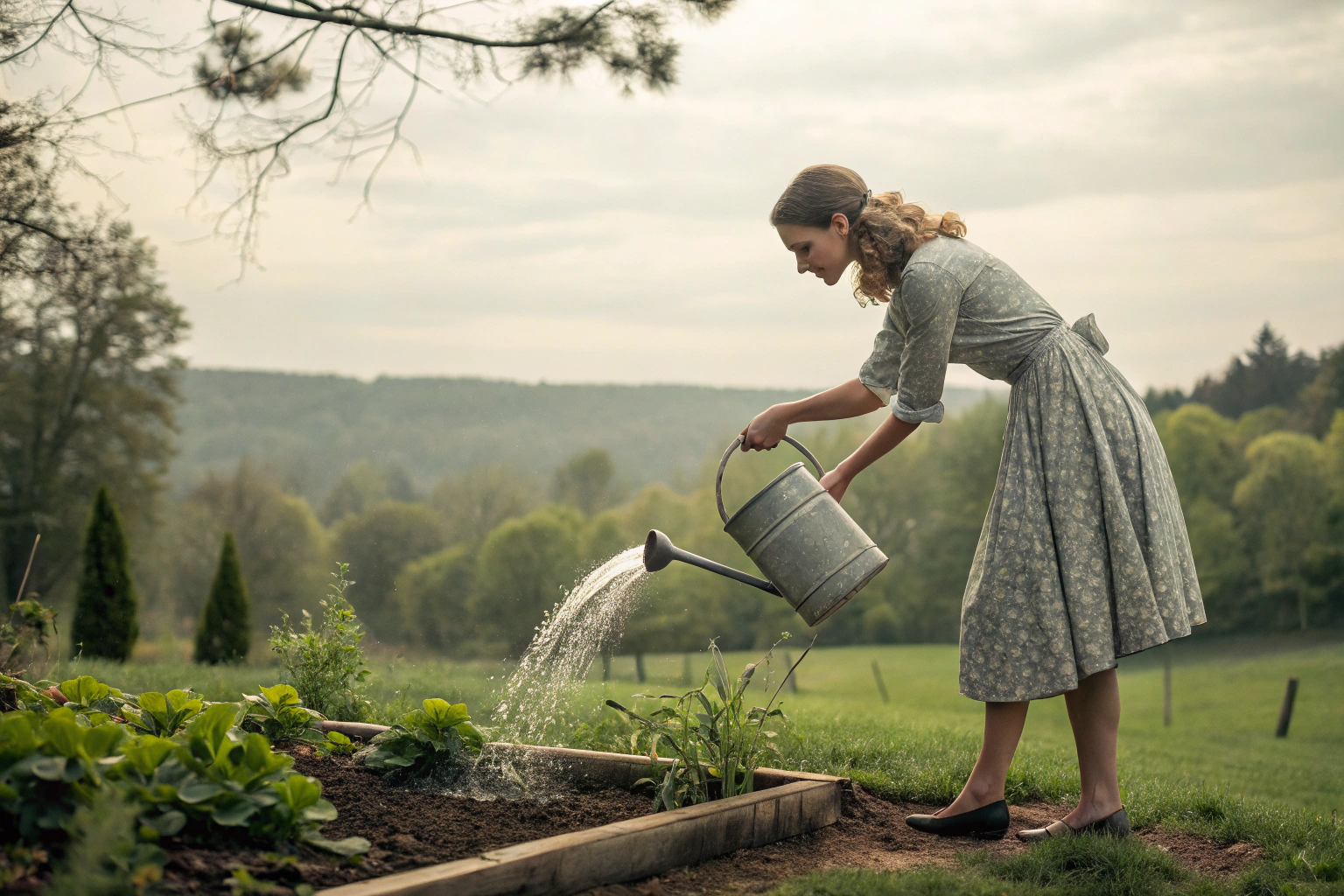
Water slowly until soil darkens and stops bubbling, then repeat to reach 6 to 8 inches depth.
- 4
Prioritize morning watering
Morning beats evening for most climates since leaves dry fast and reduce foliar disease pressure.
- 5
Tame dry mixes and baskets
Pulse pour on dry potting mix and count 5 to 8 seconds per 12 inch basket in heat waves.
- 6
Tailor care to houseplants
Let the top inch dry for tropicals, keep evenly moist for ferns, and bottom water African violets.
Pre-wet seed trays with a fine rose until water just shimmers on the surface, then bottom water by setting trays in 0.5 inch water, 1.25 cm, for 10 minutes. I sanitize the rose between batches since damping off loves communal baths.
Keep water tepid, around 68 to 72 degrees F, 20 to 22 degrees C, so roots do not flinch. Cold shock stalls growth more than gardeners admit.
Water slowly until soil darkens and stops bubbling, then wait 2 minutes and repeat for depth. I aim for 6 to 8 inches, 15 to 20 cm, of penetration by pacing my pour and checking with a trowel.
Morning beats evening for most climates since leaves dry fast. RHS guidance aligns with this, less leaf wetness means less foliar disease pressure.
Surface tension fights you in dry potting mix, so pulse pour and let it soak. If water sheets off, break the hydrophobic crust with a chopstick and try again or add a labeled horticultural wetting agent per directions.
Hanging baskets drink like athletes on a July afternoon. I count seconds, 5 to 8 seconds per 12 inch basket, 30 cm, then revisit twice in heat waves above 90 F, 32 C.
I water at the sink with a narrow spout so I can reach crowns without splashing. Many houseplants prefer rainwater if your tap runs hard, which keeps leaf tips from crisping in fluoride sensitive plants like dracaena and spider plant.
Let the top inch, 2.5 cm, dry for tropicals, keep evenly moist for ferns. Bottom water African violets to protect fuzzy leaves, then pour off the saucer after 20 minutes.
How much is enough, without guesswork
Vegetable beds usually need about 1 to 1.5 inches of water weekly, 25 to 38 mm, including rainfall per University Extension consensus. That equals roughly 0.62 gallons per square foot for 1 inch, 2.5 liters per square meter for 25 mm.
Count cans and do the math, a 2 gallon can empties 0.32 of an inch over 10 square feet, so three fills puts you near an inch. A cheap rain gauge verifies your plan better than hope.
Soil physics made useful
Clay holds water like a vault, sand lets it bolt, loam plays nice, so adjust your pour speed. Slow pours improve infiltration and reduce runoff, which keeps nutrients where roots can find them.
Containers develop a perched water table at the bottom where water lingers. I use a coarse grit layer only for drainage hole protection, not as a false drainage layer, then water until a trickle escapes so salts flush.
Fertigation with a can, safely
I feed seedlings at quarter to half strength, then watch leaf color and vigor rather than chase labels. Salts build up fast in small volumes, so I flush with plain water every third watering.
Compost tea smells like promises and occasionally trouble. I only use actively aerated brews fresh and I keep the rose scrupulously clean afterward.
Timing and temperature
Early morning watering sets plants up for the day and avoids evening snail parties. I store cans in shade so the water sits near ambient, roughly 60 to 75 F, 15 to 24 C.
Midday watering still works in heat if you go straight to the root zone. Leaves do not scorch from droplets like folklore claims, they suffer more from heat stress and shallow watering.
Care and maintenance that keeps flow smooth
Rinse after liquid feeds, then descale monthly with 1 part white vinegar to 3 parts water, soak the rose for 30 minutes. A soft brush clears mineral crust without scratching.
Replace gaskets before leaks start, and keep a spare rose in a drawer. I oil steel seams lightly before winter and store cans dry and upside down.
To disinfect after disease, use a 10 percent bleach solution for 10 minutes, then rinse thoroughly. Let parts air dry fully so chlorine dissipates.
Buying guide, matched to real jobs
Look for replaceable roses, sturdy threads, and a warranty that includes seals. Typical pricing runs 15 to 40 USD, 15 to 40 EUR, for plastic and 40 to 150 USD, 40 to 150 EUR, for metal depending on capacity and finish.
- Indoor shelf can, 0.3 to 0.7 gallons, 1 to 2.5 liters, long narrow spout, fine rose included.
- Bench work can, 1 gallon, 4 liters, quick fill opening, calibrated marks for mixing feed.
- Border can, 1.5 to 2 gallons, 6 to 8 liters, long spout, detachable fine and coarse roses.
- Accessible grip can, offset handle and light body under 1.5 pounds empty, 700 grams, for easy tip control.
- Showpiece indoor can, copper or brass, 1 to 2 liters, for gifting and daily houseplant rounds.
Pro moves I use weekly
- Pre wet dry beds, then deep soakPre wet dry beds lightly, wait 3 minutes, then finish the deep soak so water does not bolt sideways.
- Angle the rose beside the stemAngle the rose so water lands beside the stem, never in the crown of lettuce, hostas, or agaves.
- Use one tiny drop of soapUse dye-free, fragrance-free soap at one tiny drop per gallon, 4 liters, as an emergency wetting trick on hydrophobic potting mix, then flush next time.
- Weigh pots before and after wateringWeigh a pot dry and again after watering to learn your plant’s water budget, the scale teaches faster than guessing.
- Mark the can at 25, 50, 75 percentMark your can at 25, 50, and 75 percent with tape so you can dose liquid feed accurately without extra tools.
Pre wet dry beds lightly, wait 3 minutes, then finish the deep soak so water does not bolt sideways. Angle the rose so water lands beside the stem, never in the crown of lettuce, hostas, or agaves. Use dye-free, fragrance-free soap at one tiny drop per gallon, 4 liters, as an emergency wetting trick on hydrophobic potting mix, then flush next time. Weigh a pot dry and again after watering to learn your plant’s water budget, the scale teaches faster than guessing. Mark your can at 25, 50, and 75 percent with tape so you can dose liquid feed accurately without extra tools.
- Pre wet dry beds lightly, wait 3 minutes, then finish the deep soak so water does not bolt sideways.
- Angle the rose so water lands beside the stem, never in the crown of lettuce, hostas, or agaves.
- Use dye-free, fragrance-free soap at one tiny drop per gallon, 4 liters, as an emergency wetting trick on hydrophobic potting mix, then flush next time.
- Weigh a pot dry and again after watering to learn your plant’s water budget, the scale teaches faster than guessing.
- Mark your can at 25, 50, and 75 percent with tape so you can dose liquid feed accurately without extra tools.
Sources worth your time
Royal Horticultural Society offers clear watering guidance that aligns with experience in the beds. University Extension sites like Minnesota, UC ANR, and Florida IFAS publish practical thresholds for soil moisture and disease risk.
EPA WaterSense covers outdoor water budgeting and efficiency with data behind the advice. Beth Chatto’s mantra applies to watering too, right plant, right place, right amount.
Comparisons and alternatives to a Watering can
I pair a Watering can with drip in summer, drip covers baseline and the can handles edge plants and new transplants. That mix trims time and keeps hands in the soil where the story unfolds.
Quick answers
Best time to water, early morning for most climates. Best size for balcony, 1 gallon, 4 liters, so you refill less and still steer the pour. Fine or coarse rose, fine for seedlings and young roots, coarse for established shrubs and mulched beds. Rainwater or tap, rainwater for ericaceous plants and hard water zones, tap works if you flush salts in containers. How long should a can last, quality metal cans go a decade or more with care, plastics vary by UV exposure.
- Best time to water, early morning for most climates.
- Best size for balcony, 1 gallon, 4 liters, so you refill less and still steer the pour.
- Fine or coarse rose, fine for seedlings and young roots, coarse for established shrubs and mulched beds.
- Rainwater or tap, rainwater for ericaceous plants and hard water zones, tap works if you flush salts in containers.
- How long should a can last, quality metal cans go a decade or more with care, plastics vary by UV exposure.
Cheatsheet: Watering Can Mastery for Lush Gardens
Tools and Equipment
Select a watering can (1-2 gal/4-8 L, long spout for indoor, large rose for outdoors)
Watering Timing
Early morning (before 9am) or after 6pm to reduce evaporation
Efficient Watering Steps
Fill with room-temperature water (60-75°F/16-24°C), attach rose for seedlings, and water base avoiding foliage
Plant-Specific Watering
Seedlings: Mist gently. Established plants: Deep soak 1-2x/week. Potted plants: Water until drainage.
Optimizing Nutrient Uptake
Even moisture enhances nutrient uptake; hand-watering uses 40% less water than hoses.
Want a more guided way to practice watering can?
Frequently Asked Questions: Mastering the Art of the Watering Can
How often should I water plants with my watering can?
Your watering frequency dances intimately with your plant type, soil, and weather. Aim to water deeply but infrequently, waiting until the top inch of soil dries out to stimulate vigorous root growth. Over-zealous watering stifles roots; moderation births lush, thriving plants.
Does the material of my watering can matter?
Indeed. While comfort might dictate your preference, practical considerations rule. Metal watering cans radiate durability and longevity, while plastic offers lightweight maneuverability. Consider your gardening rhythm and choose material accordingly, ensuring both ease of use and endurance.
What's the ideal watering can nozzle type for seedlings?
Seedlings crave gentle nurturing rather than torrential downpours. Opt for a watering can with a fine rose attachment: its delicate spray mirrors soft rains, preventing delicate sprouts from toppling or drowning beneath harsh streams.
How can my watering can help manage water usage in my garden?
A watering can cultivates thoughtful precision. By allowing measured, controlled pours, you avoid water wastage rampant with hoses or sprinklers. Pouring deliberately directs hydration where it's most needed, establishing sustainable water conservation in your gardening routine.
Can leftover water in my watering can harm my plants?
Sitting water invites unwanted microbial guests. Always pour fresh water into your watering can before each session. Routinely empty, rinse, and air-dry your can to lead your plants toward vibrant vitality and prevent potential contamination.
How much water should I pour per plant using my watering can?
Plants whisper their hydration needs through soil moisture and visual cues. Saturate the soil gently until moisture emerges subtle but thorough from drainage holes. Adjust volume according to plant variety, size, and environmental conditions. Your watering can guides the artful balance between scarcity and flooding.
Conclusion
The watering can is old-school, but it endures for a reason. It offers precision, lets you control every drop, and gives you a front-row seat to your plants’ needs. No hose can match the intimacy. Whether you’re nurturing seedlings, coaxing blooms, or feeding veggies, this tool hands you power and restraint in equal measure. Take your time. Notice the soil, the leaves, the subtle shift in color. That’s where real effortless growth happens, one careful pour at a time. If you’re after more ways to make your garden thrive, check out these tips for maximizing your spring gardening efforts. Keep your watering can close, your eyes open, and let patience do its quiet work.


