Zone 8 Planting Guide: Essential Tips for Garden Success
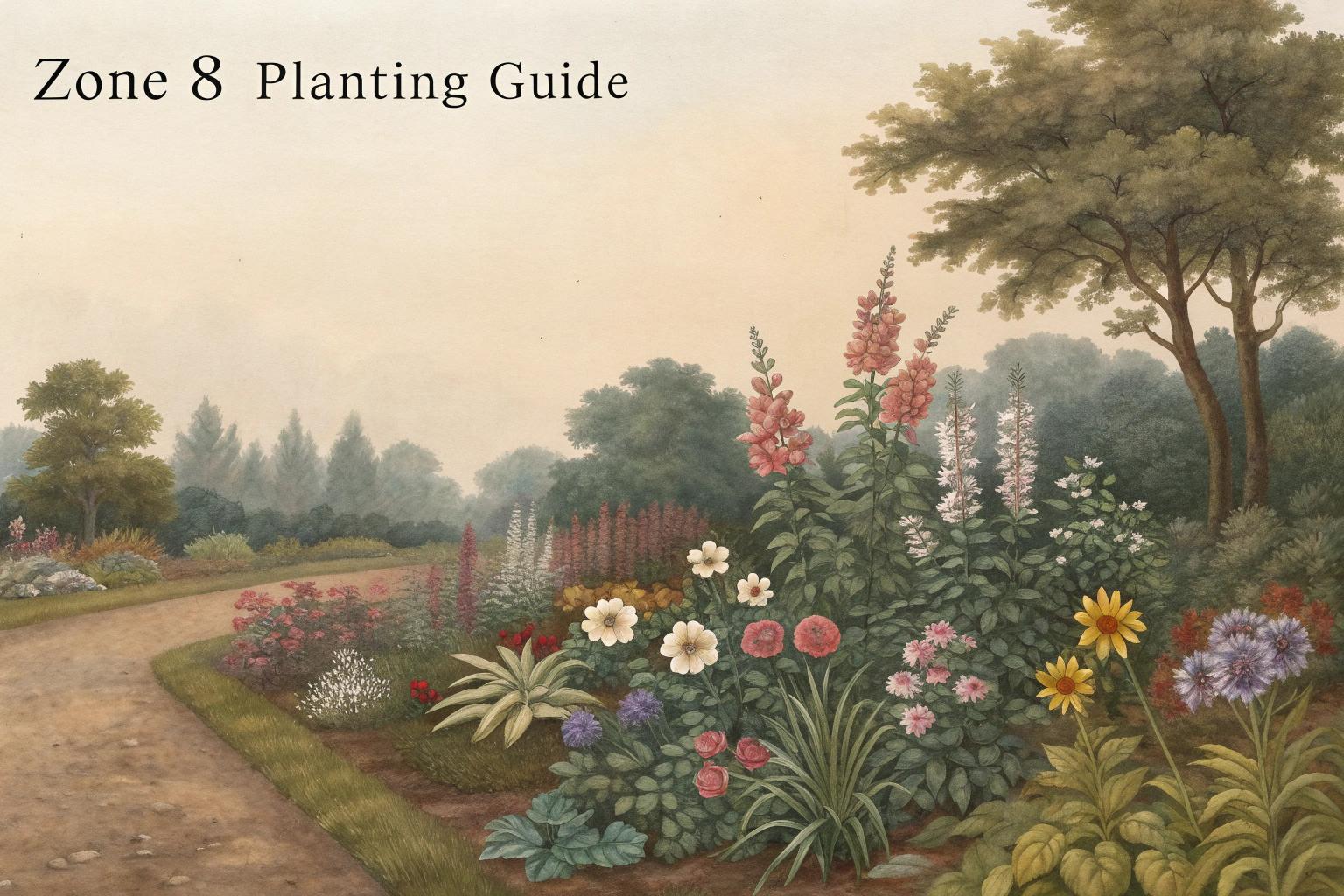
Zone 8 planting guide
rab your shovel, check the calendar and dig into this Zone 8 planting guide. Zone 8 gardeners plant confidently between frost dates, selecting heat-tolerant perennials and cool-season vegetables. Use this Zone 8 planting guide to time your seeds, prune deliberately, and let your garden thrive through every humid summer and mild winter.
Table of Contents1 sections
- Section 1· 7 min
Section 1
I built this Zone 8 planting guide after years of trial, triumph, and a few plants that melted like ice cream on a dashboard. Zone 8 gives long seasons, a mild winter, and summer heat that rewards planning.
USDA Zone 8 means average annual extreme minimums of 10 to 20 F minus 12 to minus 7 C. That sets winter survival math for perennials, trees, and shrubs.
I push one half-zone with mulch, row cover, and wind breaks. Marginal plants live if you lower winter stress and avoid soggy crowns.
Most Zone 8 gardens see last frost from early March to mid April and first frost from early November to late November. I stop guessing and plant by soil temperature with a $12 thermometer.
I also watch phenology cues. When dogwoods bloom and soil hits 60 F 16 C, my beans sprout fast.
South-facing walls add one to two heat zones for citrus or rosemary, while low spots frost first. Wind funnels between houses can desiccate tomatoes faster than heat alone.
I map the yard with a cheap IR thermometer at dusk and dawn. The warmest square gets basil and melons, the coolest pocket gets summer lettuces under 30 percent shade cloth.
Zone 8 often means clay subsoil with sandy or loamy caps. I chase infiltration with compost 1 to 2 inches 2.5 to 5 cm yearly, plus coarse mulch 2 to 3 inches 5 to 7.5 cm.
Raised beds warm earlier and drain better, which matters for early carrots. In native ground I double-dig once, then maintain with no-till and living roots.
My drip lines run 0.5 to 1 gallon per hour 1.9 to 3.8 L per hour emitters, spaced 12 inches 30 cm, with a pressure regulator and filter. I water to 8 inches 20 cm depth, then wait, which forces roots down.
Mulch after the first deep soak. Bare soil bleeds moisture and bakes biology.
Shade cloth: 30 percent for tomatoes and peppers, 40 to 50 percent for lettuce and cilantro in August. Texas A&M and UC trials show those ranges keep photosynthesis humming without spindly growth.
Morning sun and late-day shade beat the reverse in July. I foliar feed kelp lightly during heat spikes to keep stomata behavior steady, then stop once nights cool below 68 F 20 C.
Zone 8 spans many microclimates, so chill hours often land between 300 and 800 hours under 45 F 7 C. Pick cultivars that match your local chill or you get flowers with no set or leaves with no flowers.
I run low to mid-chill peaches 300 to 600 hours, high-chill apples only where winter holds. For citrus, satsuma and kumquat take brief dips to 15 to 20 F minus 9 to minus 6 C with protection.
Plant brassicas in late summer to dodge caterpillar peaks and finish in cool weather. I use light row cover 0.5 oz sq yd 17 g sq m, which adds 2 to 4 F 1 to 2 C and blocks moths.
Carrots, beets, turnips, and spinach sweeten after a nip. I harvest kale as cut-and-come-again from November to March.
Cabbage loopers and diamondback moths arrive once temps cross 70 F 21 C and brassicas scent the air. Row cover and weekly scouting at dusk save time later.
Squash vine borers demand timing. I plant early and again in late summer, wrap lower stems with foil, and use pheromone traps to read pressure.
Stink bugs nail tomatoes in late summer. I vacuum them into a jar in the morning and plant trap crops like sunflower and millet on the margins.
Fire ants love drip lines on clay. I disturb mounds early, then encourage native predatory ants by reducing broad-spectrum sprays.
Get a lab test every 2 to 3 years and adjust pH toward 6.2 to 6.8 for most vegetables. Excess phosphorus ties up micronutrients and fuels algae, so I dial compost to need, not habit.
I pre-germinate carrots on boards for 4 days in August, then flip the boards and water twice daily until sprout. Germination jumped from 40 percent to 90 percent in heat.
I charge biochar in finished compost for two weeks before application. In my silt loam, that cut irrigation by about 20 percent and steadied pH.
I plant basil on the east side of tomatoes to blunt afternoon scorch. The basil tastes better and the tomatoes keep their shoulders clean.
I solarize spring weed seedbeds with clear plastic for 4 to 6 weeks when soil hits 110 F 43 C at 1 inch 2.5 cm. Fewer weeds, fewer regrets.
USDA Plant Hardiness Zone Map for baseline temperature zoning, updated methodology in 2023. That sets the floor for perennial choices.
NOAA climate normals for local frost windows and heat accumulation. I check station data within 10 miles 16 km of my garden.
Texas A&M AgriLife Extension and University of Georgia Extension for warm-season vegetable trials and shade cloth guidance. The recommendations align with my yields.
University of California ANR and UC IPM for pest biology and chill hour models. Clear thresholds keep me from spraying out of habit.
USDA NRCS on irrigation efficiency and soil health. Their numbers match what my water meter and soil probe tell me.
- Corn: sow at 60 to 95 F soil temp 16 to 35 C.
- Beans: 60 to 85 F 16 to 29 C.
- Squash and cucumbers: 65 to 95 F 18 to 35 C.
- Lettuce: 40 to 75 F 4 to 24 C, then bolt control kicks in above 80 F 27 C.
- Late winter Feb–Mar: peas, onions, potatoes, brassicas transplants, carrots under cover.
- Spring Apr: tomatoes, peppers, squash, cucumbers after soil warms 65 F 18 C.
- Early summer May–Jun: beans, okra, sweet potatoes, melons, basil.
- Late summer Jul–Aug: seed fall carrots, beets, and chard at dusk with shade cloth and frequent misting.
- Fall Sep–Oct: brassicas again, garlic, shallots, fava beans, spinach.
- Tomatoes: 'Celebrity', 'Cherokee Purple', 'Sun Gold' for staggered maturity and heat tolerance.
- Peppers: 'Shishito', 'Jalapeño M', 'Carmen' ripen reliably before fall.
- Okra: 'Jambalaya' and 'Clemson Spineless' love 90 F 32 C days.
- Eggplant: 'Ping Tung Long' handles heat and sets fruit consistently.
- Southern peas: 'California Blackeye' fixes nitrogen and shrugs off drought.
- Sweet potatoes: 'Beauregard' roots deep and cures sweet.
- Greens for heat: Malabar spinach and New Zealand spinach stay crisp in August.
- Herbs: perennial oregano, thyme, rosemary, garlic chives, and lemongrass in warm pockets.
- Perennial anchors: figs, pomegranates, loquat, muscadine grape, and 'Natchez' blackberry.
- Soil thermometer, dial or digital: accuracy within 1 F 0.5 C.
- Drip kit with 0.5 to 1 gph 1.9 to 3.8 L h emitters, 150 mesh filter, and 15 psi regulator.
- Shade cloth: 30 percent for fruiting crops, 40 to 50 percent for leafy beds, with clips and a ridge line.
- Floating row cover: 0.5 to 0.9 oz sq yd 17 to 30 g sq m for insects and light frost.
- Mulch: arborist chips for perennials, clean straw for annuals, 2 to 3 inches 5 to 7.5 cm.
- pH meter or test kit and a reputable soil lab recommendation list from your extension office.
- Planting by date instead of soil temperature.
- Overhead watering in the evening during warm, humid spells that invites foliar disease.
- Too little mulch in summer and too much piled on stems in winter.
- Ignoring chill hours when buying fruit trees.
- Skipping succession planting, which leaves gaps in August and in February.
- Weekly water in summer: 1 to 1.5 inches 25 to 38 mm total, adjusted by mulch and soil type.
- Nitrogen for heavy feeders: 0.1 to 0.2 lb N per 100 sq ft 50 to 100 g per 9.3 sq m, split doses.
- Tomato night temps for set: best at 55 to 70 F 13 to 21 C, poor above 75 F 24 C.
- Compost rate: 1 inch 2.5 cm on beds yearly, more for sand, less for heavy clay once structure improves.
Cheatsheet: Winning Planting Moves for Zone 8
Planting Windows
Last frost: March (avg. 25°F / -4°C), First frost: Mid-Nov (avg. 30°F / -1°C). Start seeds indoors 6 weeks prior.
Top Plants for Zone 8
Veggies include tomatoes, peppers, and okra; herbs like basil and rosemary; and fruits such as figs and strawberries.
Sun, Soil & Water
Ensure at least 6 hours of direct sunlight. Maintain soil pH of 6.2–7.0. Water 1–1.5 inches weekly and mulch to retain moisture.
Health, Nutrition, Self-Sufficiency
Grow up to 60 lbs of produce per square yard, reducing grocery bills and increasing vitamin intake. Fresh herbs boost meals.
Pest & Disease Patrol
Use row covers early, rotate crops to cut disease by 80%, and plant marigolds for natural pest defense.
Tools and Products Needed
Equip with pruners, a trowel, drip system, hoe, mulch, compost, quality seeds, a soil test kit, and row covers.
Want a more guided way to practice zone 8 planting guide?
Frequently Asked Questions for Your Zone 8 Planting Guide
Which plants thrive best in Zone 8 conditions?
Lavender, rosemary, camellias, and fig trees sing praises to Zone 8's mild winters and long growing seasons. Select varieties that drink sunlight warmly and can withstand occasional frosts.
What planting schedule suits Zone 8 best?
Timing is your ally. Early spring whispers to cool-season vegetables like kale, spinach, and peas, while late spring warmly embraces heat-lovers such as tomatoes, peppers, and eggplants. Fall offers a mellow encore for leafy greens and root vegetables.
How often should plants be watered in Zone 8?
Deep, infrequent watering invites roots to journey deeper into the earth. Water thoroughly about once a week during dry conditions, giving soil a chance to breathe between sessions. Adjust frequency according to rainfall and plant maturity.
Can tropical plants survive Zone 8 winters outdoors?
Some tropical beauties, like banana plants and elephant ears, can brave mild Zone 8 winters outdoors, provided you mulch generously and shield them from harsh winds. Others, like hibiscus or plumeria, prefer winters indoors or a greenhouse hideaway.
What soil amendments best enrich Zone 8 gardens?
Feed your garden's appetite with generous helpings of organic compost, aged manure, and occasional doses of bone meal or blood meal. These ingredients invigorate soil structure, enhance fertility, and honor your plants' intrinsic cravings for nourishment.
How can gardeners protect Zone 8 plants during unexpected frosts?
Unexpected frosts demand improvisation. Employ floating row covers, blankets, or even festive holiday lights strung gently to provide warmth. Mulching heavily around roots helps maintain soil warmth, shielding tender plants when the temperature dips.
Conclusion
Growing in Zone 8 means learning to dance with the seasons—mild winters, long growing stretches, and the occasional weather curveball. With the right soil prep, well-timed planting, and a sharp eye on your watering routine, you’ll see real results. Go for nutrient-dense vegetables and mix in companion planting to get more out of each square foot. Tools matter—don’t skimp on a solid garden fork or a trusty garden hose. This Zone 8 planting guide isn’t about perfection. It’s about working with what you’ve got, reading your space, and making practical choices. Remember: plant with intention, pay attention, and the rest falls into place.


